Davos, Switzerland | 20 January 2026
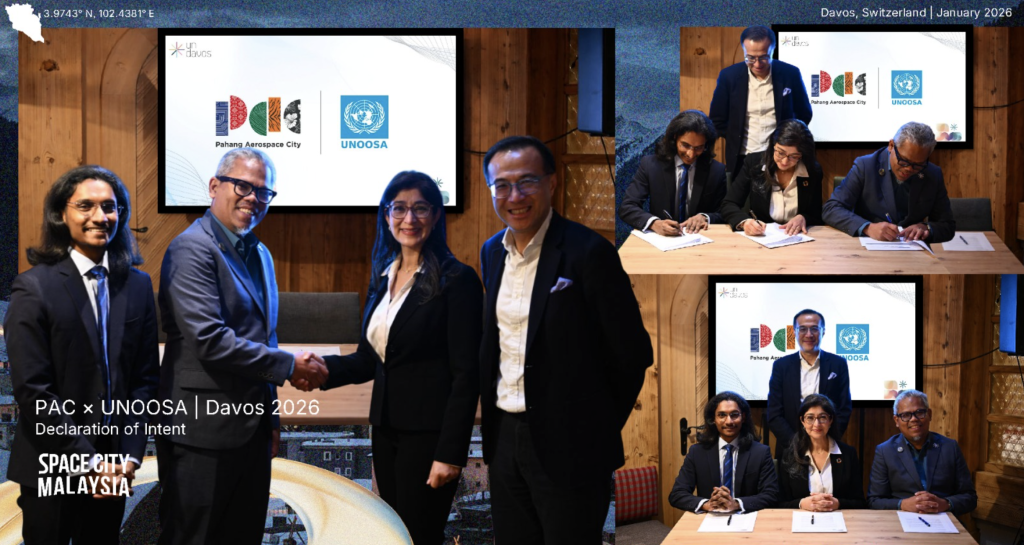
Pahang Aerospace City Development Berhad (PAC) has taken a significant step in positioning Malaysia within the global space ecosystem through a Declaration of Intent with the United Nations Office for Outer Space Affairs (UNOOSA), exchanged in conjunction with the World Economic Forum Annual Meeting 2026 in Davos.
The Declaration of Intent reflects a shared, non-binding commitment to explore a potential framework for cooperation focused on policy advisory support, inclusive space economy development, capacity-building, and knowledge exchange, aligned with international norms and best practices.
During the engagement, PAC’s Managing Director, Adj. Prof. Muhamad Nurazmi Abas, presented Malaysia’s integrated Space City and Omniport development vision within PAC’s 11,328-acre master-planned development to UNOOSA Director, Ms. Aarti Holla-Maini. The presentation outlined how large-scale infrastructure, space-enabled services, data platforms, and international cooperation could be structured into a single, future-ready ecosystem.
The Space City initiative is uniquely supported by the Royal House of Pahang, reflecting a long-term national and regional commitment to future infrastructure, space-enabled development, and international collaboration. The engagement with UNOOSA forms part of a broader series of strategic dialogues currently underway with foreign governments and institutions, including counterparts from the United Arab Emirates, Finland, and Scotland, as Malaysia advances its positioning within the global space economy.
The Declaration of Intent outlines areas for potential cooperation including alignment with international space law and governance frameworks, particularly the United Nations space treaties development of sustainable and inclusive space-enabled economic models, structured knowledge exchange through expert dialogues and workshops, and engagement on space data, downstream applications, innovation ecosystems, and talent development. It further establishes a pathway for continued institutional dialogue, with the understanding that any future activities would be elaborated through separate arrangements defining specific modalities of collaboration.
“Our Space City initiative is designed as part of an integrated Omniport model, where aviation, space infrastructure, data, and urban development are planned as a single system,” said Adj. Prof. Nurazmi. “Engaging with UNOOSA at this early stage ensures that governance, capacity-building, and inclusive space principles are embedded into our development framework from the outset, rather than added later.”
Rajeeshwaran Moorthy, Board Advisor to PAC, underscored the importance of sequencing and international confidence. “As space becomes increasingly central to economic and strategic systems, platforms like PAC must be designed to interface responsibly with the international order. This Declaration of Intent signals Malaysia’s intent to position its Space City initiative as an open, multilateral platform, where global principles can be translated into real-world delivery.”
PAC’s Davos engagement builds on momentum generated at the Dubai Airshow 2025, where the organisation concluded multiple international engagements across aerospace, space, advanced mobility, and innovation ecosystem, reinforcing Malaysia’s credibility as a platform builder for future industries.
PAC’s participation in Davos forms part of a wider strategy to convert global interest into structured, long-term cooperation, beginning with non-binding institutional frameworks and progressing, where appropriate, toward defined collaborations.
About Pahang Aerospace City Development Berhad (PAC)
Pahang Aerospace City Development Berhad (PAC) is the master developer and coordinating entity for the Pahang Aerospace City initiative, a long-term, integrated development focused on aerospace, space-enabled infrastructure, advanced mobility, digital innovation, and sustainable urban growth. The Space City initiative is supported by the Malaysian Space Agency and is designed to serve as a platform for international cooperation, technology deployment, capacity-building, and inclusive economic development in line with global best practices.
About the United Nations Office for Outer Space Affairs (UNOOSA)
The United Nations Office for Outer Space Affairs (UNOOSA) works to promote international cooperation in the peaceful and sustainable use of outer space. As the custodian of the United Nations space treaties, UNOOSA supports Member States in developing legal, policy, and institutional frameworks for space activities, facilitates capacity-building and access to space-related benefits, and advances the use of space science and technology for sustainable development.